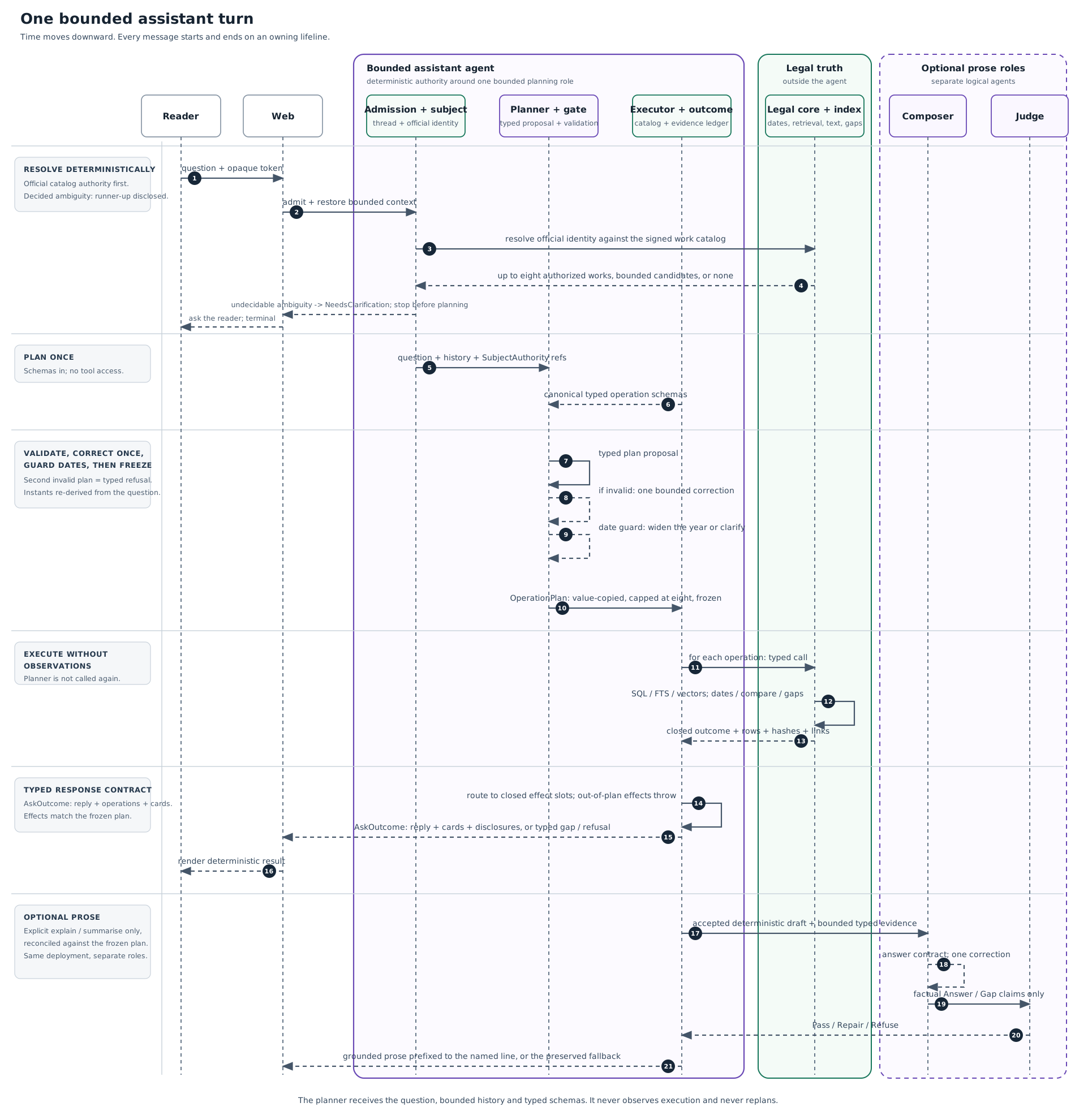
Architectural decision: bounded plan -> validate and correct once -> guard dates -> freeze -> execute. ReWOO-inspired reasoning without an observation loop, not adaptive ReAct. Identity resolves in code before any model runs; the planner proposes one typed plan over a closed catalog; code validates, freezes and executes it; optional prose is composed and judged only on explicit request and can only lose to the typed reply, never replace it.
Open the sequence diagram at full size
What crosses each boundary
Every component hands the next one a typed object, never prose. Code marks deterministic application code; model marks a bounded Azure OpenAI call with a typed output. Cards reach the reader as each operation completes, but the plan is frozen before the first one runs and the reply is assembled once at the end.
| From | To | Object | Carries | Cannot carry |
|---|---|---|---|---|
| Subject preflight, code | Planner, model | SubjectAuthority |
opaque subject_1..N refs, up to eight, with the works they stand for; an optional article number; an optional runner-up disclosure; or a clarification that ends the turn |
a law name or identifier the planner could rewrite |
| Planner, model | Plan gate, code | proposed plan | tool names from the closed catalog and typed arguments; work may only be an offered ref |
anything outside the schema: one correction, then a typed invalid request |
| Plan gate and date guard, code | Executor, code | OperationPlan |
one to eight frozen operations, value-copied, each with its declared effects and recorded repairs; a bare year widened to its window or turned into a clarification | a later change; the plan is sealed |
| Executor, code | Outcome router, code | execution results | per operation a closed legal outcome, transport outcome, rows, hashes, permalinks or a typed gap; the evidence ledger, 64 entries and 96,000 characters | an effect outside the frozen declaration, which throws |
| Outcome router, code | Composer, model, optional | draft and ledger | the already final typed reply and its evidence items with ids | text the ledger does not hold |
| Composer, model | Judge, model | AgentAnswerDraft |
claims bound to evidence ids kind to kind, permalinks byte-identical to evidence, already validated in code | a number or article absent from the cited excerpts |
| Judge, model | Outcome router, code | AgentGroundingJudgment |
Pass, Repair or Refuse | a replacement reply; anything but Pass keeps the typed result |
| Outcome router, code | Web | AskOutcome |
the named reply, per-operation results, closed effect cards, forced disclosures, trace, timings | model prose without its typed result underneath |
What the model may never do
- Choose the law. Identity is resolved against the signed catalog before planning; a decided ambiguity proceeds with the runner-up disclosed, an undecidable one asks.
- Observe a result and replan. One correction before freeze for a contract-shape error; nothing after.
- Pick a date by itself. The date guard re-derives every planned instant from the question.
- Call the index, the legal core or public MCP. The executor calls the in-process core; MCP is a separate projection of the same operations, not the planner's transport.
- Emit a confidence number or an unchecked claim. Prose claims cite evidence ids; permalinks, numbers and article names are checked in code; the judge returns Pass, Repair or Refuse.
Code owns these through WorkResolutionGuard, WorkSubjectRule, OperationPlan,
OperationArguments, DateIntentGuard, UiMapper, AgentAnswerContract and AgentAnswerFinalizer.
Bounds
- Admission: 200 accepted turns per client address and 400 globally per UTC day by default, four concurrent; idempotency key and evaluation admission checked at the web boundary.
- Deadlines: planner 12 s, first typed result 25 s, optional synthesis 45 s; on expiry the deterministic result is returned as is.
- Synthesis activates only when the planner sets
synthesis=truebecause the reader explicitly asks to explain, and the flag is reconciled against the frozen plan, never against the reader's words, which quoted content controls: a plan of inventories alone (coverage,cited_by,in_force_on) has it cleared, because those lists are already rendered in full. There is no hidden UI toggle. - Composer and judge are two logical Microsoft Agent Framework roles with separate sessions on the same configured Azure OpenAI deployment used by Ask; one format or evidence correction for the composer; the judge runs only for Answer or Gap drafts with factual claims.
- Two prompt-injection canaries, a current-turn and a restored-transcript probe, run against every candidate revision before promotion.
- No LangChain or LlamaIndex: catalog, plan schema, executor, outcomes and evidence contracts are explicit application code.
Conversation memory
Open the memory boundary diagram at full size
| Boundary | Holds | Bound |
|---|---|---|
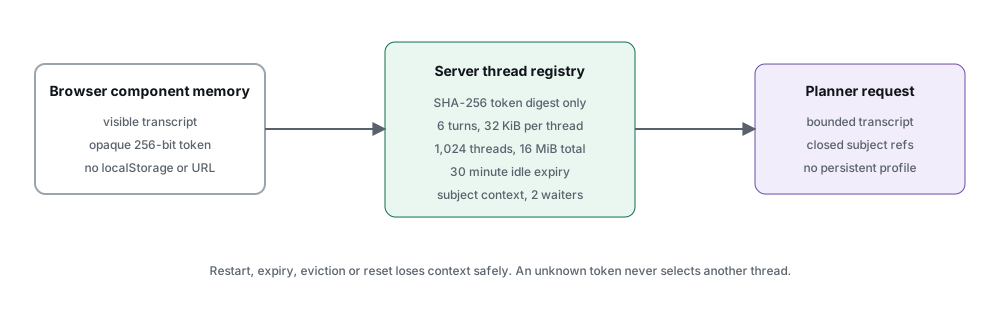
| Browser | The visible transcript and the opaque token, in component memory, never local storage | Lost on reload; an unknown token never falls through to another conversation |
| Server thread registry | Accepted turns and deterministic subject context, keyed by the token's SHA-256 digest only | 1,024 threads, six turns, 32 KiB per thread, 16 MiB globally, two waiters, 30-minute idle lifetime |
| Planner request | The restored bounded transcript and the authorized subject refs | Nothing persistent; restart, expiry, eviction or reset loses the thread safely |
The objects, expanded
Each object that crosses a boundary, with its fields as declared in code. Click a name to expand.
SubjectAuthority
Members        : List<SubjectAuthorityMember>
ArticleNumber  : string, optional
Disclosure     : AnswerDisclosure, optional
References     : subject_1 .. subject_N, derived, N at most eight
SubjectAuthorityMember
Work            : string, for example eu-eurlex:32016r0679
Title           : string, optional
Mentions        : List<string>, the reader's words that matched
ArticleAnchor   : string, optional, for example art_33
ExactLexId      : string, optional, when a full version key was named
AuthoritySource : identifier, title, short_title or provision
AnswerDisclosure
RunnerUpWork  : string, optional
RunnerUpTitle : string, optional
Instant       : Stated, DefaultedToToday or WidenedFromYear
OperationPlan
RequestId          : string
Locale             : string
Operations         : RequestedOperation[1..8], value-copied, sealed
SynthesisRequested : bool, reconciled against the plan at freeze
RequestedOperation
OperationId            : string
UserOrder              : int
Tool                   : one of the ten legal operations, legal_boundary or clarification
Arguments              : typed JSON, at most 32,768 bytes
ResultClass            : LegalResultClass, optional
Disposition            : ApplicationDisposition, optional
Effects                : declared OperationEffect list; an effect outside it throws
Repairs                : "action.argument outcome" lines recorded by the gate and the date guard
OperationResult
OperationId      : string
LegalOutcome     : one of nine closed outcomes
TransportOutcome : one of five closed outcomes
Effects          : within the frozen declaration
Payload          : rows, hashes, permalinks, or a typed gap
AgentEvidence
Id                         : tool:call:ordinal
Kind                       : one of seven evidence kinds, no pointer kind
Work, Anchor, Date         : identity of the evidence
TextSha256, Permalink      : what the claim can be checked against
RequiresCoverageDisclosure : bool
Title, Excerpt             : bounded text
AgentAnswerDraft
Status             : answer, gap, clarify or refusal
Answer             : string, at most 6,000 characters
Claims             : AgentClaim[], each with Text, Kind and EvidenceIds
Permalinks         : must be byte-identical to used evidence
CoverageDisclosure : string, optional
AgentGroundingJudgment
Disposition : pass, repair or refuse
Issues      : at most five
Replacement : string, only with repair
AskOutcome
Status              : HTTP status
Body                : reply, trace, clarification, ui, operations, model_usage, model_identity, timing
RetainForReplay     : bool
ContextDisposition  : Preserve, Replace or Clear
UiEffect slots      : Provision, Diff, History, Timeline, Ranking, InForce, CitedBy, Coverage, Verification, Workspace, Gap